

Goal and scope
Serve LLM inference on Kubernetes the way a platform team would. Every operational concern (GPU scheduling, routing, tenancy, secrets, scaling, model delivery, observability) is an explicit, forkable decision rather than a managed black box. The design target is a stack that runs the same on any GPU-capable cluster and grows from a single scale-to-zero GPU to a multi-tenant, HA deployment without rearchitecting. It integrates open-source components; it does not reinvent them. The one hard boundary: infrastructure-as-code owns the cloud substrate; GitOps owns everything inside Kubernetes. Neither crosses into the other’s half. That split keeps a fork portable instead of a pile of provider-specific glue.The layers
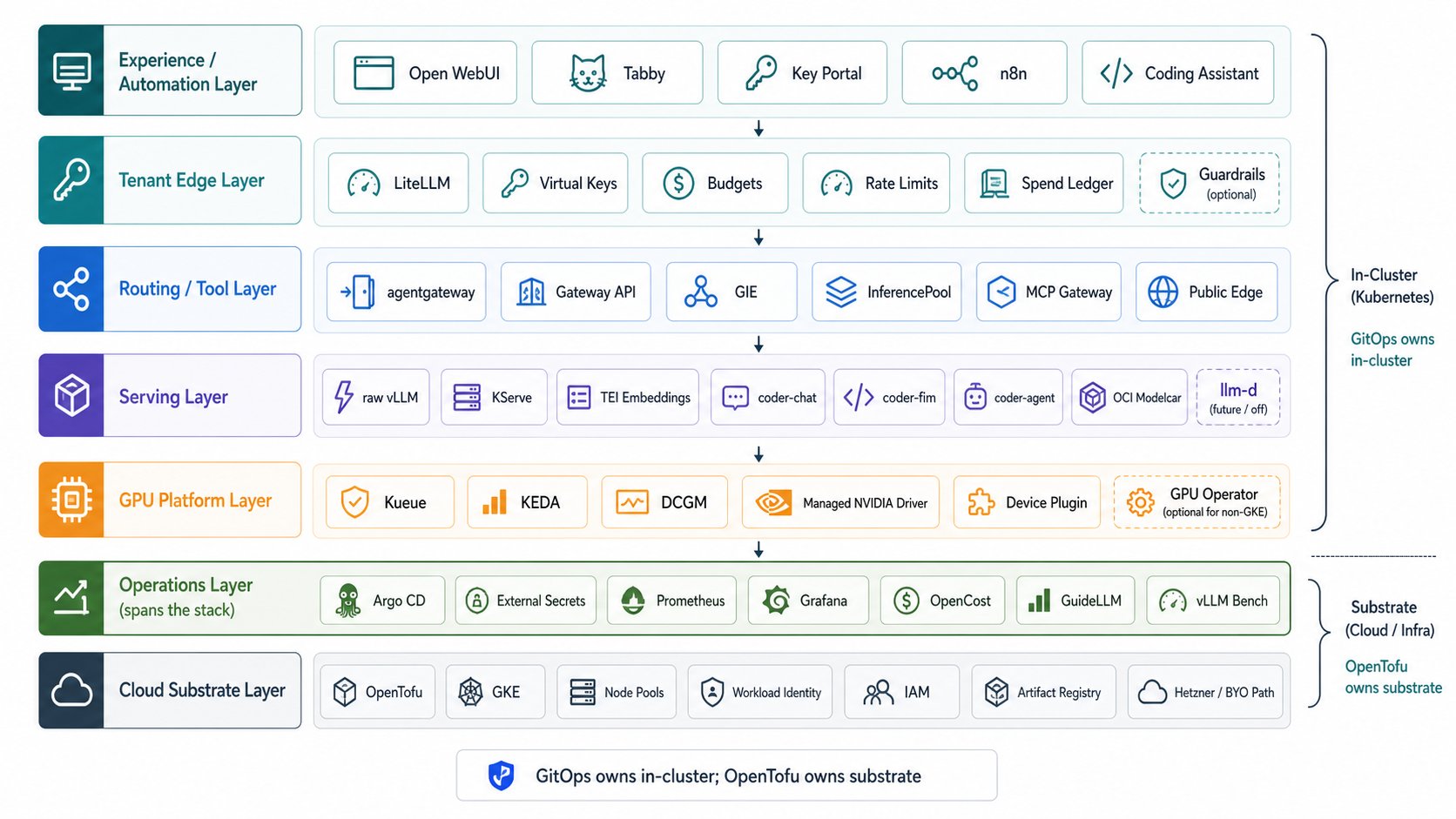
- Tenant edge: LiteLLM. One OpenAI
/v1facade with virtual keys, per-key/team budgets, rate limits, and a spend ledger. This is where tenancy economics live. - Routing: Gateway API + GIE. Inference-aware endpoint selection (KV-cache, queue depth,
model/canary splits) via an
InferencePooland endpoint-picker, on agentgateway (no Istio). Distinct from the tenant edge: one is economics, the other is request routing. - Serving: vLLM / KServe. Raw vLLM is the default (full control, minimal moving parts); KServe
InferenceServiceadds managed lifecycle (canary, scale-to-zero, model governance) where it earns its control plane. See Serving layers compared. - GPU platform. The NVIDIA driver, device plugin, and DCGM metrics (managed on GKE; the NVIDIA GPU Operator off GKE), with Kueue for quota/admission and KEDA for queue-depth autoscaling.
- Substrate & delivery. OpenTofu provisions the cluster and identity; Argo CD reconciles the whole in-cluster stack from git as an app-of-apps. Secrets sync keylessly via External Secrets Operator; observability is Prometheus + Grafana + DCGM + vLLM metrics.
- Cost visibility. OpenCost attributes real infrastructure cost (node, GPU, memory cost) per workload from the same Prometheus, feature-gated. It complements the LiteLLM spend ledger: token economics from the gateway, infrastructure cost from OpenCost.
Platform topology
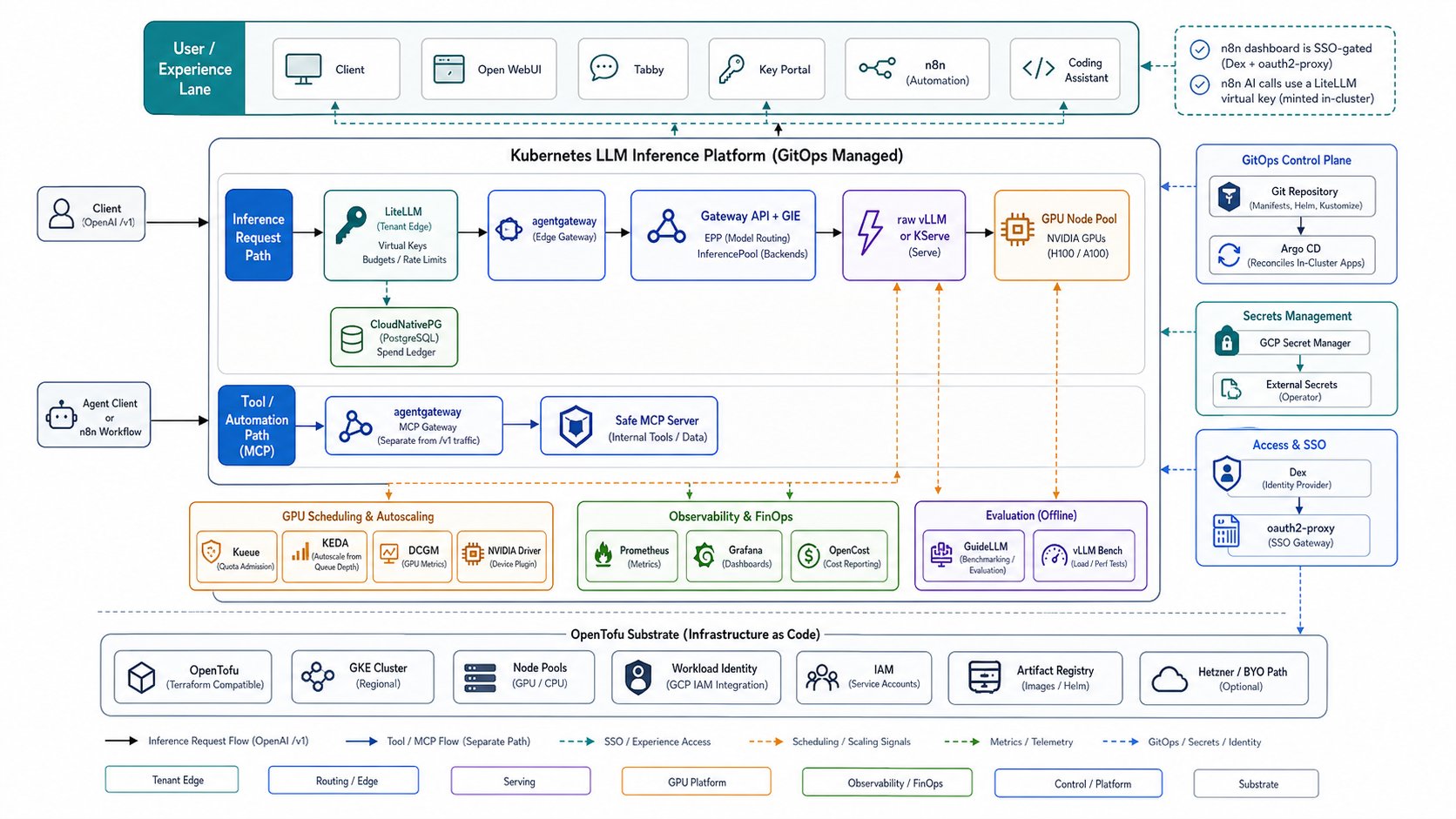
The full platform has more than one path through the cluster./v1 inference requests go through
LiteLLM and the inference router. MCP tool traffic is a separate route through agentgateway. n8n is
an experience-layer automation surface: its dashboard is SSO-gated, and its AI calls use a LiteLLM
virtual key rather than bypassing the tenant edge.
Full topology diagram
Full topology diagram
Request path
A single chat completion crosses the tenant edge, the router, and the model server. The edge owns identity and economics; the router owns endpoint selection; the model server owns the GPU.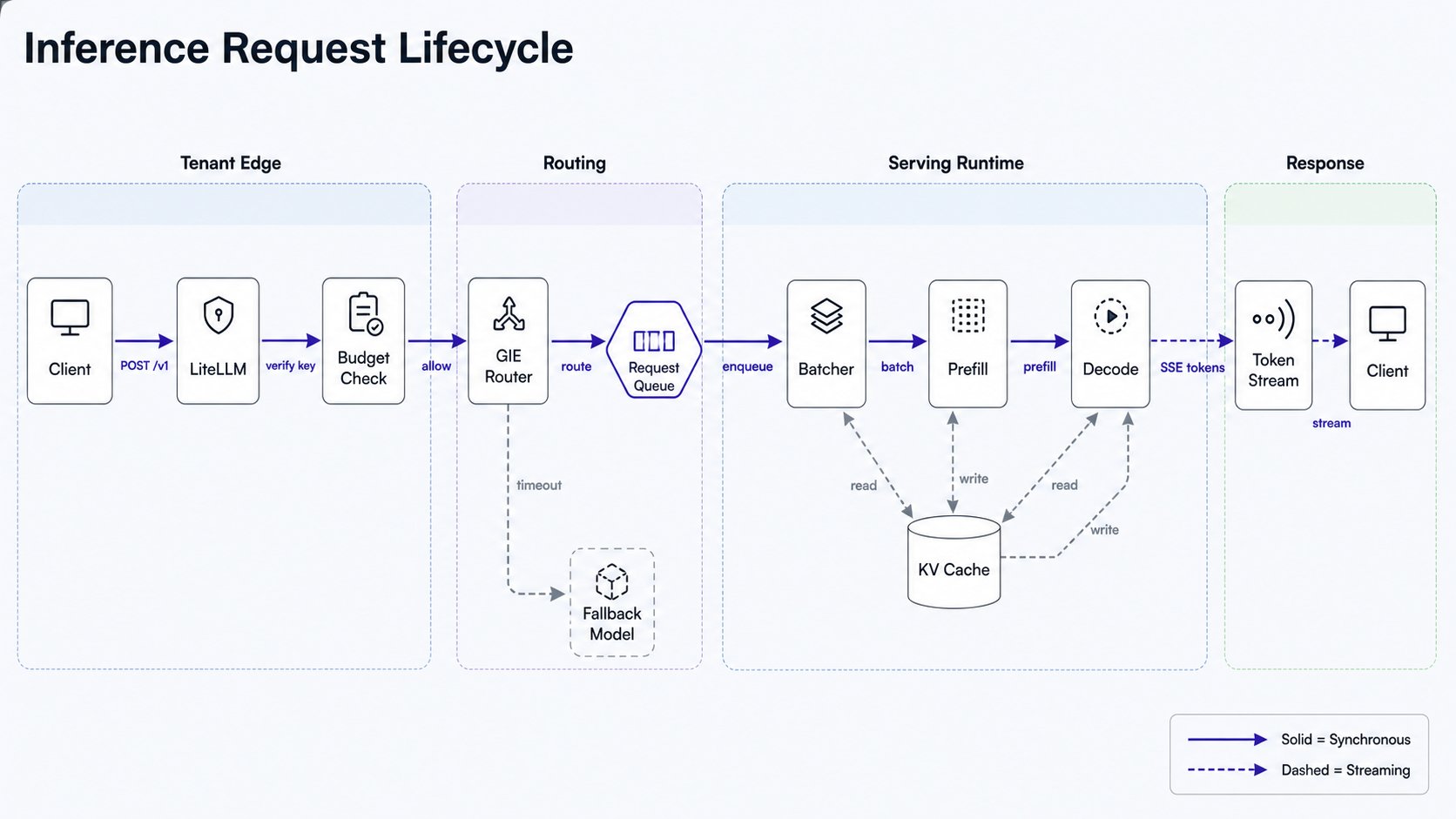
Exact request sequence
Exact request sequence
Components and status
Component versions and maturity. Validated means exercised end-to-end on GPU.
Deferred capabilities: LLM-level tracing (Langfuse), alerting, multi-GPU fair-share, GPU
time-slicing, RAG, and MLOps lifecycle. These are tracked with explicit adoption triggers, not
designed out.
Operational model: IaC, GitOps, and the one-time steps
The platform is declarative end to end. After a one-time bootstrap, Argo CD reconciles the entire in-cluster stack from git (platform, serving, routing, gateway, experience, and secrets via External Secrets). Day-2 operation is 100% git: change a manifest, Argo applies it. A short list of steps is imperative because they sit below GitOps (they create the cluster and the GitOps engine) or handle values that cannot live in git:
The only capability that is genuinely outside infrastructure-as-code is container image builds: the
model-delivery image (an OCI modelcar with the weights baked in) is produced by a registry build, not a
declarative manifest. Pre-built public images are provided so a fork serves the default model with no
build step; building a different model is a documented, opt-in step.
Go deeper
- Concepts: the non-obvious decisions behind the platform.
- Serving layers compared: raw vLLM vs KServe, same model and engine.
- Guides: operate each layer.
- Get started: configure, provision, install.