

Qwen2.5-0.5B-Instruct) on the same engine (vLLM v0.23.0),
so this compares the serving layer, not the engine. raw vLLM is serving/raw-vllm (see
Benchmarks); KServe is serving/kserve. Both expose the OpenAI API, and the
KServe path is fronted by the same agentgateway as the GIE routing layer. Operational gotchas: the
KServe guide.
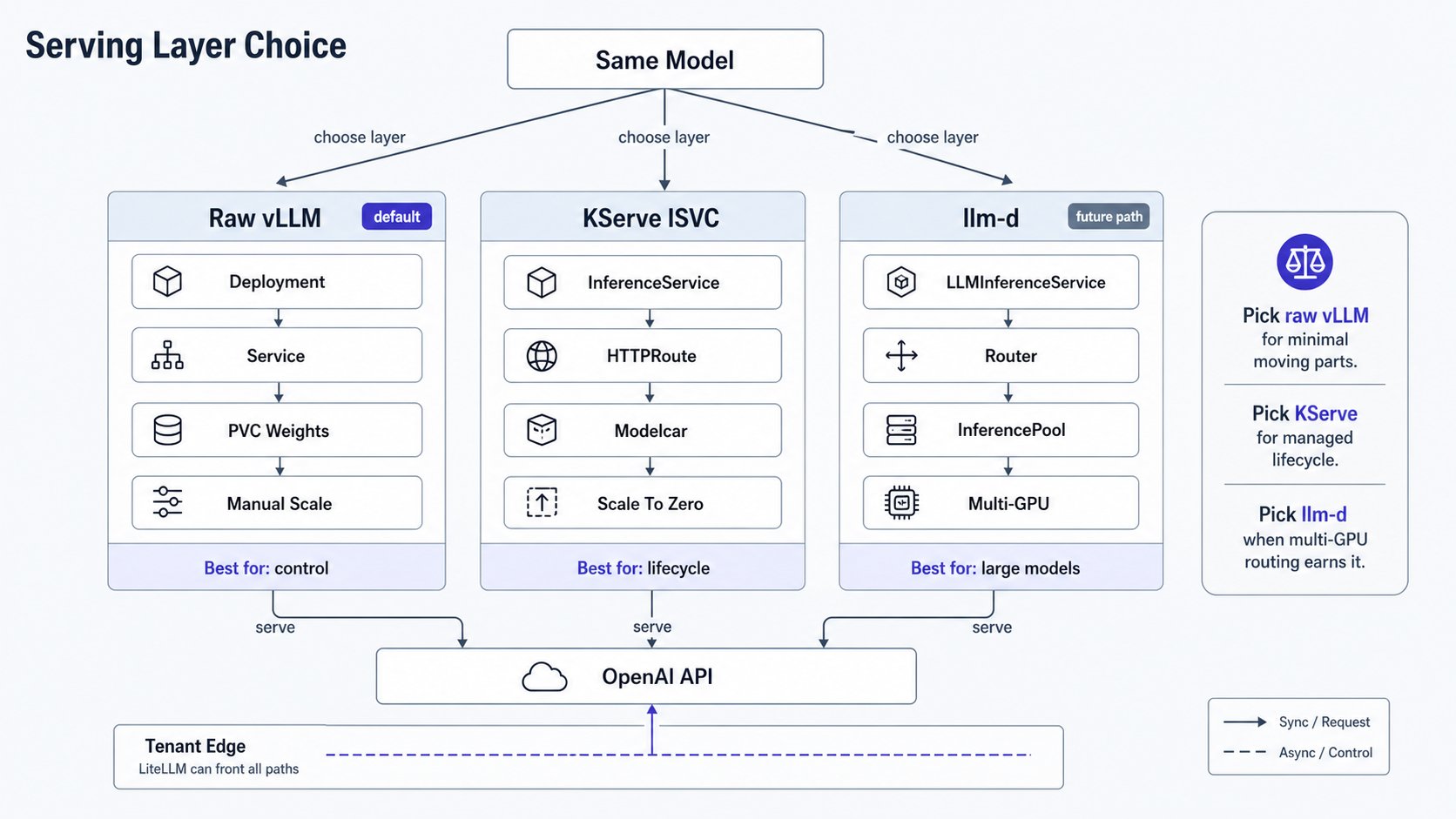
What KServe buys (and what it costs)
Buys: the platform owns model lifecycle: a stable per-model URL, declarative canary, native scale-to-zero, and one CR contract across every model a team ships. That is the difference between “I deployed a model” and “we operate a model-serving platform.” Costs: a control plane to run (cert-manager + controller) and a set of opinionated behaviours that fight you until you know them: a default cpu limit of 1, themodel+runtime
/mnt/models injection, an Istio VirtualService path unless disabled (all in the runbook). raw vLLM has
none of that surface because it does none of that work.
When to use which
- Raw vLLM: one model, one team, full control, you own rollout/scale. The right call for a single benchmarked endpoint.
- KServe
InferenceService: you want lifecycle/canary/scale/ingress/governance handled declaratively across many models. LLMInferenceService: a future path for large/multi-node models needing disaggregated serving and KV-aware routing (llm-d); it overlaps the GIE routing layer.
Confirmed behavior
The same model answers an OpenAIchat.completions request on both layers. KServe path: the
InferenceService reaches Ready, GET /v1/models returns qwen2.5-0.5b, and
POST /v1/chat/completions returns 200 (system_fingerprint vllm-0.23.0) through the agentgateway,
identical to the raw vLLM endpoint. Weights load from a pre-staged volume rather than a live
Hugging Face pull, which is also the more air-gap-friendly pattern.