

The ownership boundary
Two systems own two halves of the platform, and the split is hard:- OpenTofu owns the cloud substrate. The cluster, node pools, Workload Identity, IAM, and
Artifact Registry. Everything under
infra/. Argo CD never touches it. - Argo CD owns everything inside Kubernetes. Controllers, CRDs, workloads, and secret sync, reconciled from this repository by GitOps. OpenTofu never touches it.
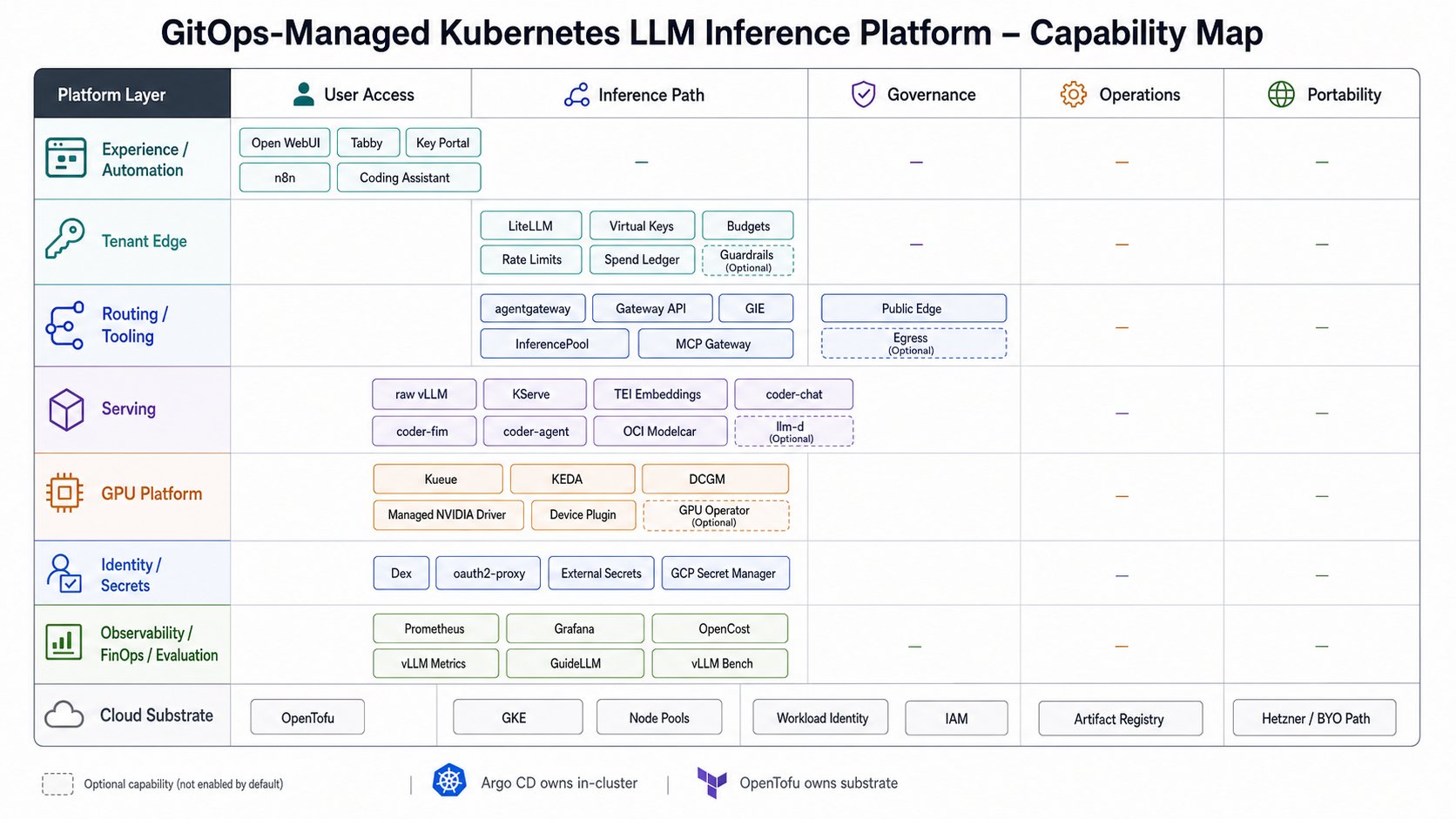
Top-level directories
How a component is wired
A running component appears in three places:- The implementation lives under the matching top-level directory (
platform/,serving/,routing/,workloads/) as Helm values or manifests. - A child Argo
Applicationpoints at it fromclusters/<cluster>/catalog/<group>/. These directories hold only plainApplicationYAML, so adirectory.recursesource renders them cleanly. - A capability flag in
config.yamldecides whether that group’s Applications exist at all.
- Profile selects which layers you apply, with
make root PROFILE=…. See make targets. - Features select which capability groups exist, through
config.yaml. Runmake resolve-groupsto regenerateclusters/<cluster>/groups.generated.yaml. - Bring-up is each Application’s own sync policy: a manual-sync app is created but not deployed until you sync it.
.generated.yaml are build artifacts. Regenerate them with the resolver scripts
rather than editing by hand.